
India’s E20 Petrol Transition: Energy Security, Farmer Income, Mileage and the Trade-Offs Explained
India's shift to petrol blended with 20% ethanol—commonly called E20—has become one of the country's most significant changes in transport-fuel policy.
The idea is straightforward.
Instead of every litre of petrol being produced entirely from petroleum, E20 contains approximately:
80% petrol + 20% ethanol
Ethanol is a renewable alcohol-based fuel that can be produced from agricultural and biomass feed stocks such as sugarcane derivatives, maize, damaged food grains and other approved sources.
India's ethanol program has expanded rapidly. Ethanol blending in petrol was below 1.5% in 2013–14, crossed 10% in 2022 and reached approximately 20% by 2025–26, achieving the government's E20 objective earlier than the original 2030 timeline.
But the importance of E20 goes beyond the number printed on a fuel dispenser.
The program affects India's crude-oil imports, foreign-exchange requirements, agricultural markets, vehicle technology, fuel efficiency and environmental policy.
It also creates legitimate questions for motorists—particularly owners of vehicles designed before higher ethanol blends became the national standard.
Understanding E20 therefore requires looking at both its strategic benefits and its practical trade-offs.
What Exactly Is E20 Petrol?
E20 means petrol containing approximately 20% ethanol and 80% conventional petrol by volume.
Ethanol contains oxygen and has a relatively high octane rating. When blended appropriately with petrol, it can contribute to cleaner combustion and improve anti-knock characteristics.
However, ethanol also has a lower energy content per litre than conventional petrol.
That creates one of the most important trade-offs with ethanol-blended fuel:
higher ethanol content can help reduce petroleum consumption, but vehicles that are not optimized for the blend may experience some reduction in fuel economy.
This distinction matters because environmental, energy-security and consumer-efficiency questions are not the same thing.
How India Reached 20% Ethanol Blending
India's Ethanol Blended Petrol Program is not a recent experiment.
The program began in the early 2000s and expanded gradually as ethanol availability, distillation capacity, fuel infrastructure and vehicle technology developed.
A major acceleration came with the National Policy on Biofuels, 2018.
India subsequently achieved approximately 10% ethanol blending in June 2022, ahead of the targeted schedule.
E20 began being introduced at selected retail outlets in February 2023.
The blending rate subsequently rose to around:
12.06% in 2022–23
14.60% in 2023–24
about 19.2% in 2024–25
and around 20% during 2025–26.
Government reporting in 2026 describes E20 as the standard around which India's petrol-fuel system and new-vehicle standards are now being built.
Why Is India Pushing Ethanol So Aggressively?
The main strategic reason is India's dependence on imported crude oil.
India imports the overwhelming majority of the crude oil it consumes.
That makes the economy vulnerable to:
- international crude-oil price spikes;
- geopolitical conflict;
- shipping disruptions;
- currency depreciation;
- supply restrictions in major oil-producing regions.
Replacing part of petrol with domestically produced ethanol does not eliminate India's dependence on crude oil.
But at national scale, even replacing part of every litre can reduce the amount of petroleum that must be imported.
That is why ethanol blending is primarily an energy-security strategy, rather than simply a policy designed to make fuel cheaper at the pump.
How Much Has Ethanol Saved India?
Government estimates illustrate the scale the program has reached.
By mid-2026, government reporting said the Ethanol Blended Petrol Program had cumulatively:
- saved more than ₹1.9 lakh crore in foreign exchange;
- substituted roughly 316 lakh metric tonnes of crude oil;
- reduced around 952 lakh metric tonnes of CO₂ emissions; and
- transferred more than ₹1.6 lakh crore to Indian farmers through the ethanol ecosystem.
These numbers are government estimates and should be understood as cumulative program-level calculations rather than a direct reduction in every consumer's fuel bill.
The broader economic effect is nevertheless significant.
Money that would otherwise leave India to purchase part of its petroleum requirement is increasingly supporting domestic ethanol production, distilleries, agricultural supply chains and related infrastructure.
Why Farmers Matter to the Ethanol Story
Ethanol creates an additional industrial market for agricultural feed stocks.
India initially relied heavily on the sugar industry for fuel ethanol.
Approved feed stocks have subsequently expanded and can include sources such as:
- C-heavy molasses;
- B-heavy molasses;
- sugarcane juice or syrup;
- damaged food grains;
- maize;
- certain rice supplies;
- other permitted feed stocks.
This diversification matters.
For sugar producers, ethanol can provide an alternative use for sugarcane-derived material.
For maize growers, increasing ethanol demand creates an additional commercial market.
The government has also used administered procurement prices and policy incentives to encourage ethanol production.
For example, government data for Ethanol Supply Year 2025–26 listed a provisional procurement price of around ₹71.86 per litre for maize-based ethanol, before additional costs such as taxes, transportation and handling.
So ethanol policy increasingly connects India's agricultural economy with its energy economy.
Does Ethanol Automatically Increase Farmer Income?
Not every farmer benefits equally.
The impact depends on:
- Which crops are being used;
- Farm-gate prices;
- Ethanol procurement policy;
- Geography;
- Distillery access;
- Crop yields;
- Transport costs;
- Alternative uses of the crop.
It is therefore more accurate to say:
The ethanol program creates additional demand and income opportunities for agricultural feed stocks.
It should not be interpreted as guaranteeing higher income to every farmer.
That distinction is important.
The Food-versus-Fuel Question
One of the most important debates surrounding ethanol is whether crops that could be used as food should instead be converted into fuel.
This is not a uniquely Indian issue.
Bio fuel policies around the world have faced similar questions.
India's challenge is to expand ethanol production without creating undesirable pressure on:
- Food availability;
- Crop prices;
- Agricultural land;
- Groundwater;
- Irrigation demand.
That makes the composition of India's future ethanol supply as important as the blending target itself.
Using damaged grains, residues, second-generation biomass and less water-intensive feedstocks can potentially reduce some of these pressures.
Water Use Is a Genuine Policy Consideration
Sugarcane is a particularly important issue because it is highly water-intensive.
The government's own 2021 ethanol roadmap discussed the water footprint of ethanol production and specifically recommended encouraging greater use of less water-intensive crops.
The report noted that sugarcane remains commercially attractive for ethanol production while also consuming substantial irrigation water.
It identified maize as comparatively less water-intensive among the grain options examined.
This means ethanol should not automatically be described as environmentally beneficial simply because it is renewable.
The complete environmental equation depends on factors such as:
where the crop is grown, how much irrigation it requires, how the ethanol is produced, and what fossil fuel it replaces.
That is a much more meaningful way to evaluate sustainability.
Does E20 Reduce Carbon Emissions?
Government assessments say ethanol blending has reduced life cycle greenhouse-gas emissions compared with the petroleum it replaces.
But this should be understood carefully.
Burning ethanol still produces carbon dioxide.
The climate argument is based partly on ethanol's biogenic carbon cycle: plants absorb CO₂ as they grow, and some of that carbon is later released when ethanol is burned.
The actual life cycle benefit depends on:
- crop cultivation;
- fertilizer use;
- irrigation;
- transport;
- ethanol-processing energy;
- land use;
- the feed stock involved.
Therefore the most useful statement is not that ethanol is “zero-emission fuel.”
It is:
Ethanol can reduce life cycle greenhouse-gas emissions relative to conventional petrol when produced through appropriate feed stocks and production pathways.
What About Vehicle Mileage?
This is one of the most important questions for Indian motorists.
Ethanol contains less energy per litre than petrol.
That means increasing ethanol concentration can affect fuel economy unless the engine has been designed and calibrated to take advantage of the blend's characteristics.
The NITI Aayog ethanol roadmap published in 2021 estimated potential fuel-efficiency reductions with E20 of approximately:
6–7% for four-wheelers originally designed for E0 and calibrated for E10;
3–4% for two-wheelers designed for E0 and calibrated for E10;
and around 1–2% for four-wheelers designed for E10 and calibrated for E20-type use.
These were engineering estimates from the transition roadmap—not a guarantee of the mileage change every motorist will experience.
Actual fuel economy also depends on vehicle design, driving style, traffic, tyre pressure, air-conditioning use, maintenance and engine calibration.
Modern engines designed specifically for E20 can make better use of ethanol's higher octane characteristics and reduce some of the efficiency penalty.
Does E20 Damage Engines?
This question requires more nuance than either:
“E20 destroys engines”
or:
“E20 can never affect any vehicle.”
Government agencies say extensive testing involving automobile manufacturers, ARAI, SIAM, oil companies and research institutions preceded the transition.
The Petroleum Ministry reported in 2026 that it had not identified a widespread pattern of engine failure attributable to E20.
At the same time, compatibility can differ between vehicle generations.
Older fuel systems may use certain rubber, plastic or sealing materials developed for lower ethanol concentrations.
Vehicle manufacturers have also provided varying guidance for some older models.
The sensible consumer approach is therefore straightforward:
Check the vehicle manufacturer's E20 compatibility information, owner's manual or authorized service network—especially for older vehicles.
Owners should rely on the specifications for their exact model rather than generalized social-media claims.
Newer Vehicles and E20
India's transition was designed to occur alongside changes in vehicle standards.
Vehicle manufacturers progressively moved toward ethanol-compatible materials and E20-ready engine calibration as the national roadmap advanced.
Government policy states that from April 2026, BS-VI petrol vehicles must meet the relevant E20 emission standards.
As the vehicle fleet turns over, the proportion of vehicles engineered specifically around E20 should therefore continue to increase.
This does not mean every older petrol vehicle is automatically unusable.
It means the difference between material compatibility and engine optimization becomes especially important.
A vehicle may be able to operate on E20 without suffering catastrophic damage while still not achieving the fuel economy of an engine specifically optimized for E20.
Why Isn't E20 Petrol Much Cheaper?
A common assumption is:
Ethanol is domestically produced, so petrol containing ethanol should automatically cost substantially less.
The economics are more complicated.
Government procurement prices for ethanol have increased materially as policymakers sought to make production attractive to farmers and distillers.
The government's July 2026 explanation noted that, at prevailing procurement prices and certain crude-oil price levels, ethanol could actually cost more to procure than the equivalent refined-petrol component.
That means the objective of E20 is not simply:
“mix a cheaper liquid with petrol.”
The policy also values:
- lower crude-oil dependence;
- greater domestic energy production;
- rural income;
- lower exposure to global supply shocks;
- environmental benefits.
Whether this produces lower retail petrol prices at any particular moment depends on crude prices, ethanol procurement costs, taxation and the broader fuel-pricing structure.
E20 and India's Energy Security
The strongest strategic argument for ethanol becomes visible during periods of global disruption.
Suppose an international crisis sharply increases crude-oil prices or interrupts supply.
India cannot control the world oil price.
But if approximately one-fifth of the petrol blend comes from domestically produced ethanol, part of the transport-fuel supply is less directly exposed to imported crude.
This does not make India independent of oil.
Petrol remains the majority component of E20, while diesel, aviation fuel, petrochemicals and many other products still depend heavily on crude oil.
Ethanol should therefore be viewed as one component of energy diversification, alongside:
- Electric vehicles;
- Renewable electricity;
- Natural gas;
- Bio fuels;
- Sustainable aviation fuels;
- Public transport;
- Efficiency improvements.
The Current Consumer Debate
E20 has also generated considerable public debate.
Some vehicle owners have raised concerns over mileage, older-vehicle compatibility and the limited availability of lower-ethanol alternatives.
In August 2026, India's Chief Economic Adviser publicly suggested—expressing a personal view—that policymakers could consider restoring an E10 option alongside E20 to address consumer concerns.
Government policy at present continues to support E20, while officials say vehicle failures have not emerged on the widespread scale sometimes claimed online.
This debate illustrates an important principle:
A national energy policy can produce strategic benefits while still creating legitimate consumer-level trade-offs.
Both issues deserve consideration.
E20 Is Not the Same as E85 or Flex Fuel
E20 should also not be confused with higher ethanol blends.
E20: approximately 20% ethanol.
E85: can contain around 85% ethanol and is intended for specially designed flex-fuel vehicles.
Flex-fuel vehicles can operate across a wider range of ethanol-petrol mixtures because their materials, sensors and engine-management systems are designed accordingly.
The government said in July 2026 that no nationwide decision had been taken to move ordinary petrol beyond E20; higher blends such as E85 are being considered separately in the context of flex-fuel vehicles.
What Happens Beyond E20?
India has already created substantial ethanol-production capacity.
The next policy challenge is no longer simply:
“Can India reach 20%?”
It has.
The more important questions now are:
How sustainably can India produce the ethanol required?
Which feedstocks should supply it?
Can water consumption be reduced?
How should older vehicles be handled?
Should consumers have multiple fuel-blend choices?
What role should ethanol play as electric vehicles become more common?
Can second-generation ethanol and agricultural waste reduce dependence on food crops?
These questions will determine whether India's ethanol strategy remains economically and environmentally sustainable over the long term.
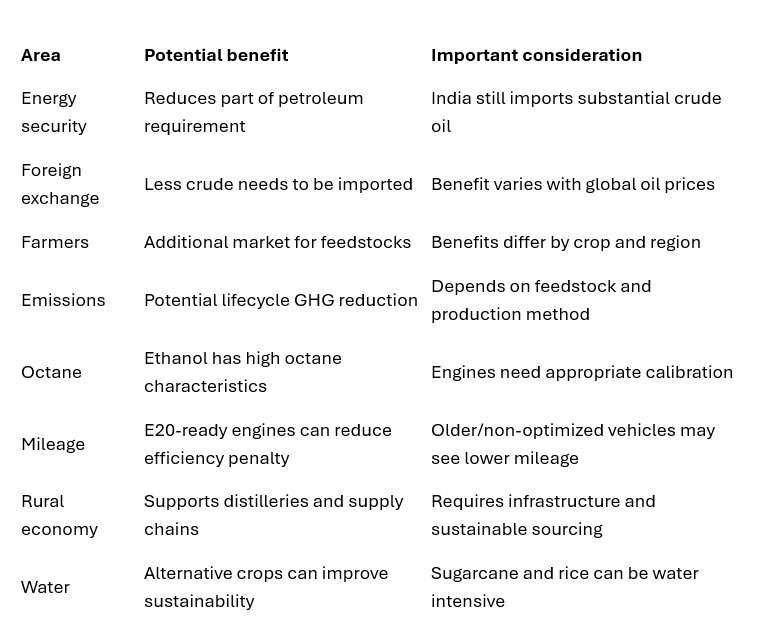
Benefits and Trade-Offs at a Glance

What Motorists Should Do
For most vehicle owners, the practical steps are simple.
Check your owner's manual or fuel-tank label.
Look for E20 compatibility information.
Use manufacturer guidance for your exact vehicle.
Do not assume advice for one model applies to another.
Monitor fuel economy over several tankfuls rather than one journey.
Traffic and driving conditions can distort one-tank comparisons.
Maintain the vehicle properly.
Tyre pressure, engine condition, filters and driving style can influence mileage substantially.
For an older vehicle, ask the authorized service centre about E20 compatibility.
This is more reliable than relying on viral videos or generalized claims.
Key Takeaway
India's E20 programme has moved from policy ambition to national-scale implementation.
Its strategic logic is clear.
Replacing part of imported petroleum with domestically produced ethanol can strengthen energy security, reduce foreign-exchange outflows, create new agricultural demand and potentially lower lifecycle greenhouse-gas emissions.
But E20 is not a policy without trade-offs.
Fuel economy can differ depending on vehicle design. Older vehicles require greater compatibility awareness. Expanding ethanol production also raises legitimate questions about water use, feedstock selection and the balance between food and fuel.
The most useful way to understand E20 is therefore neither as a miracle fuel nor as a national automotive disaster.
It is a large-scale energy transition whose success depends on economics, agriculture, technology, environmental sustainability and consumer acceptance working together.
That balanced perspective is more useful than either promotional claims or alarmist misinformation.
Sources and Methodology
Ministry of Petroleum & Natural Gas / Press Information Bureau: Ethanol Blending in India, policy milestones and 2026 program statistics.
NITI Aayog: Road map for Ethanol Blending in India 2020–2025, including vehicle-efficiency estimates, compatibility considerations and analysis of feed stock water requirements.
Government of India / Parliamentary and PIB releases: ethanol blending levels, procurement framework, crude substitution, foreign-exchange savings and farmer-payment estimates.
Automotive industry and manufacturer guidance: vehicle-specific compatibility should always be confirmed with the relevant manufacturer.
Government programme statistics quoted above represent official estimates. Vehicle mileage figures from the 2021 roadmap are engineering estimates and should not be interpreted as a guaranteed real-world outcome for every vehicle.
Editorial Note
Last reviewed: 18 August 2026
Content type: Energy / Economy / Automobile education
Policy status reviewed: India E20 ethanol-blending programme
This article aims to distinguish verified policy information from generalized claims circulating around ethanol-blended petrol.
Disclaimer
This article is intended solely for educational and informational purposes.
It does not constitute automotive, investment, environmental, agricultural or public-policy advice. Vehicle compatibility varies by manufacturer, model and production year. Owners should consult their vehicle manual or manufacturer before making decisions based on fuel compatibility.
Official ethanol policies, fuel specifications, procurement prices and blending requirements may change over time.
Comments (0)
Be the first to comment.
About the author

NISM-Series-X-A Investment Adviser Level 1 examination completed
Amit writes about Indian equity markets, technical analysis, macro themes and the day-to-day mechanics of trading, with a focus on making the flow of global markets legible for retail investors. He has completed the NISM-Series-X-A Investment Adviser Level 1 examination.
You May Also Like

Big Tech Gains $750B as AI Data Centre Stocks Crash
Global Markets & Economy · Nov 5, 2026 · 12 min read
Big Tech Gains $750 Billion After US Midterms, but AI Data-Centre Stocks Crash: Is Wall Street Rewarding Less AI Spending? Key Takeaway: Wall Street's reaction to the 2026 US midterm elections has exposed a surprising divide in the artificial intelligence investment boom. Established technology giants rallied, with five major companies on course to add more than $750 billion…
Read more...
US Midterm Elections 2026: Impact on Stocks, Dollar & India
Global Markets & Economy · Nov 4, 2026 · 10 min read
US Midterm Elections 2026: Why Treasury Yields, the Dollar and Indian Stocks Could React More Than Wall Street Key Takeaway: Democrats have won control of both chambers of the US Congress in the 2026 midterm elections, creating a divided government under President Donald Trump. The immediate market reaction has been revealing: US Treasury yields declined, the dollar weakened…
Read more...
Apple Overtakes Nvidia: Is Lower AI Spending Winning?
Technology & Sectors · Nov 2, 2026 · 9 min read
Apple Overtakes Nvidia as World's Most Valuable Company Ahead of Earnings: Is Spending Less on AI Becoming Wall Street's Winning Strategy? Key takeaway: Apple has reclaimed the title of the world's most valuable publicly traded company, overtaking Nvidia as investors reassess the enormous cost of artificial intelligence infrastructure. With Apple's upcoming earnings in focus…
Read more...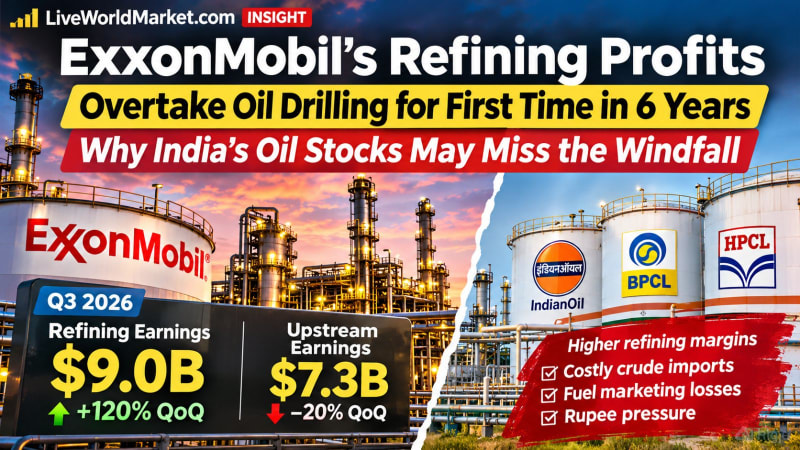
ExxonMobil Refining Profits Surge: Impact on Indian Oil Stocks
Commodities & Energy · Nov 1, 2026 · 8 min read
ExxonMobil's Refining Profits Overtake Oil Drilling for First Time in 6 Years: Why India's Oil Stocks May Miss the Windfall Key Takeaway: ExxonMobil's refining business has emerged as a bigger earnings contributor than oil production, highlighting an extraordinary shift in global energy markets. But Indian oil companies such as IOC, BPCL and HPCL face a different challenge…
Read more...
Fed Decision and Microsoft–Google Earnings: Two Critical Tests for the AI Stock Market Rally
Global Markets & Economy · Oct 28, 2026 · 15 min read
Global stock markets are approaching one of the most important financial evenings of October 2026. The U.S. Federal Reserve is preparing to announce its latest interest-rate decision, while Microsoft and Alphabet, Google's parent company, are scheduled to publish quarterly earnings after Wall Street closes. These developments arrive as investors reassess the sustainability of…
Read more...
JetBlue Stock Surges 20%, Bond Yield Tops 30%: Warning?
Global Markets & Economy · Oct 28, 2026 · 16 min read
JetBlue Stock Surges 20% While Its Bonds Yield Over 30%: Is Airline Debt Flashing a Warning for Investors? Something unusual is happening in the U.S. airline industry. Shares of JetBlue Airways surged approximately 20% on October 27, after the airline raised its revenue outlook and attempted to reassure investors about its financial position. But an entirely different story…
Read more...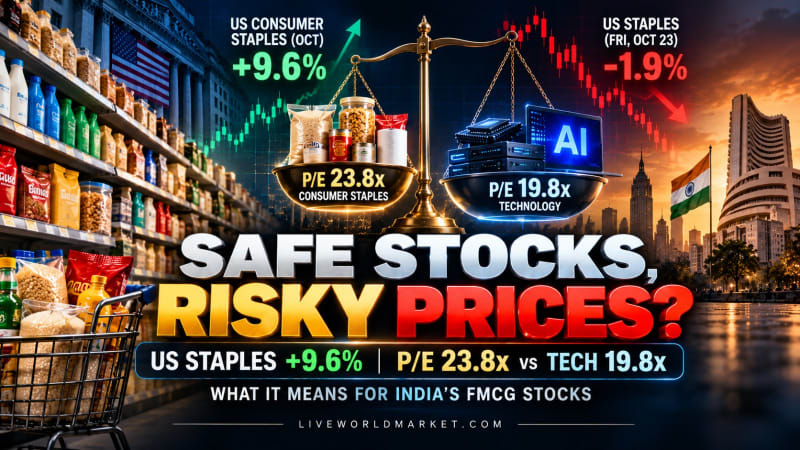
US Consumer Staples Rally 9.6%: FMCG Valuation Risk for India
Global Markets & Economy · Oct 25, 2026 · 16 min read
US Consumer Staples Surge 9.6% as Valuations Overtake Tech: Is the Safe-Stock Trade Becoming a Trap for Indian FMCG Investors? Something unexpected is happening on Wall Street. As investors become increasingly cautious about expensive artificial intelligence stocks, money has been moving into an unlikely market leader: consumer staples. The U.S. consumer-staples sector has…
Read more...
SpaceX 80,000 Cell Sites: Will Starlink Challenge Jio & Airtel?
Global Markets & Economy · Oct 24, 2026 · 17 min read
SpaceX's 80,000 Cell-Site Plan Sends US Telecom Stocks Down 8%: Could Starlink Disrupt Jio and Airtel Next? A major shift may be emerging in the global telecommunications industry—and Wall Street has already started reacting. Shares of American telecommunications giants AT&T and T-Mobile plunged nearly 8% on October 23 after reports revealed that Elon Musk's SpaceX was…
Read more...
US 10-Year Treasury Yield Below 5%: Growth Shock Warning?
Central Banks & Rates · Oct 23, 2026 · 17 min read
US 10-Year Treasury Yield Falls Below 5% Despite $114 Oil: Is the Bond Market Warning of a Global Growth Shock? Something unusual is happening across global financial markets. The yield on the benchmark U.S. 10-year Treasury has fallen sharply below the psychologically important 5% level, even as Brent crude oil has surged toward $114 per barrel and technology stocks have…
Read more...
Brent Crude Tops $110: Impact on Indian Stocks & Earnings
Global Markets & Economy · Oct 22, 2026 · 14 min read
Brent Crude Tops $110: Why Indian Airlines, Paints and Tyre Stocks Face a Hidden Earnings Risk Brent crude oil has climbed above $110 per barrel, intensifying concerns that rising global energy prices could squeeze corporate profit margins, increase India's import costs and create further volatility in domestic equities. On October 22, Brent futures traded above $111 after…
Read more...