
Jio IPO 2026: $108 Billion Valuation Amid Global AI Selloff

Jio IPO at $108 Billion Amid Global AI Stock Selloff: Can India's Biggest IPO Defy the Tech Market Rout?
India is preparing for what could become its largest-ever initial public offering at a time when global investors are reassessing technology valuations, artificial intelligence spending and the financial sustainability of digital infrastructure.
Jio Platforms, the digital and telecom business backed by Reliance Industries, is targeting a valuation of approximately $108.3 billion through a proposed ₹30,213 crore IPO.
The issue is scheduled to open for public subscription on October 21 and close on October 23, with anchor-investor bidding taking place on October 19.
The timing is particularly significant.
While Jio is seeking to attract global capital, U.S. technology stocks have suffered a sharp selloff. The Nasdaq Composite declined approximately 4.5% during the week ending October 16, as investors questioned AI infrastructure financing and expensive growth-stock valuations.
Yet Jio presents a different investment proposition.
Unlike some emerging AI infrastructure companies that depend heavily on borrowing to fund future growth, Jio already operates one of the world's largest telecommunications networks, with more than 533 million subscribers.
That established customer base provides a foundation for recurring revenue, while 5G, broadband, cloud computing and AI services offer additional growth opportunities.
The central investment question: Can Jio's existing telecom cash flows and India's expanding digital economy justify a $108 billion valuation even as global investors become more cautious about technology stocks?
1. Jio IPO 2026: Price Band, Issue Size and Important Dates
Jio Platforms plans to issue 270 million new shares at a price band of ₹1,065–₹1,119 per share.
At the upper end of the price band, the offering would raise approximately ₹30,213 crore.
The implied valuation could reach approximately $108.3 billion, depending on the exchange rate and final pricing.
The offering is expected to surpass Hyundai Motor India's ₹27,859 crore IPO in 2024, making it the largest Indian public offering by issue size.
Jio IPO Key Details

IPO dates and terms are based on the reported offer documents and timetable. Investors should verify final details through official exchange filings.
The size of the transaction makes it a major test of investor appetite for India's digital economy.
Related: Follow the Indian Stock Market.
2. Why the Jio IPO Is Arriving at a Critical Moment
Global technology markets are experiencing a period of heightened uncertainty.
The recent Nasdaq selloff reflects concerns about elevated valuations, large AI-related capital expenditures and rising borrowing costs.
Some AI infrastructure operators have attracted scrutiny because their expansion requires substantial investment in GPUs, data centers, electricity and networking infrastructure.
Investors are increasingly asking whether future revenue will generate enough cash to justify those expenditures.
Jio enters this environment with an important distinction.
Its existing telecom network generates revenue from millions of subscribers who pay for connectivity and related services.
This does not eliminate financial risk.
Telecommunications remains a capital-intensive business that requires spending on spectrum, network equipment, maintenance and technology upgrades.
However, an established subscriber business can offer greater revenue visibility than a company relying primarily on future AI infrastructure demand.
The Market's Changing Question
During the initial AI investment boom, investors focused heavily on revenue growth and the size of future opportunities.
Now, they are paying closer attention to cash flow, debt obligations, return on invested capital and the time required to recover infrastructure spending.
Jio's IPO may reveal whether global investors are willing to pay a premium for a technology-enabled business with an established revenue base.
3. Jio's Biggest Strength: More Than 533 Million Subscribers
Jio's telecom business provides the foundation for its investment story.
As of June 2026, the company reported approximately 533.3 million subscribers.
Its average revenue per user, or ARPU, reached ₹215.6 in the first quarter of FY27, compared with ₹181.7 in FY24.
ARPU is one of the most important indicators for telecommunications companies.
It measures average monthly revenue generated per user and helps investors evaluate monetization.
Why Rising ARPU Matters
An increase in ARPU can support revenue growth even when subscriber additions slow.
Higher-value plans, increased data consumption and service bundling can contribute to improved monetization.
However, ARPU growth does not automatically translate into equivalent profit growth.
Network expenses, spectrum costs, depreciation, financing charges and competitive pricing all affect profitability.
The Next Growth Opportunity
Jio also has opportunities to expand through:
- Migration of users from older mobile technologies to 4G and 5G.
- Increased data consumption.
- Home broadband adoption.
- Enterprise connectivity.
- Digital services and cloud computing.
- AI-related products and platforms.
The important question is how effectively these opportunities can be converted into sustainable earnings and free cash flow.
4. Why the IPO's Fresh-Issue Structure Matters
One notable feature of the offering is that it consists entirely of newly issued shares rather than an offer for sale by existing shareholders.
This distinction is important.
In an offer for sale, proceeds generally go to the shareholders selling their stakes.
In a fresh issue, proceeds are received by the company, before applicable expenses.
Jio plans to use a substantial portion of the proceeds to repay or prepay borrowings at Reliance Jio Infocomm.
Approximately ₹27,500 crore has been earmarked for this purpose.
Why Debt Repayment Could Help
Reducing borrowings may improve the company's financial flexibility.
Potential benefits include lower future interest expenses, reduced refinancing exposure and greater capacity to fund future investment.
However, the actual financial impact will depend on which loans are repaid, their interest rates, repayment terms and the group's remaining obligations.
The IPO should therefore be assessed not only as a growth story but also as a balance-sheet transaction.
A successful capital raise could improve Jio's financial position while providing investors with direct exposure to its digital business.
5. Jio Versus Global AI Infrastructure Companies: Two Different Investment Models
The comparison between Jio and AI infrastructure operators is especially relevant in the current market.
Jio's primary business is telecommunications connectivity, supported by an established subscriber base.
AI-focused infrastructure operators often invest heavily in specialized computing capacity to serve customers developing or deploying artificial intelligence.
Both models require capital investment, but their revenue structures and financial risks differ.
Telecom-Led Digital Infrastructure
Jio earns recurring revenue from connectivity services and is expanding into adjacent digital businesses.
Investors can evaluate subscriber numbers, ARPU, network investment, margins and operating cash flow.
AI Data-Center Infrastructure
AI infrastructure operators invest in GPUs, computing facilities and related systems.
Their returns depend on customer contracts, utilization, financing costs, equipment life cycles and operating expenses.
Semiconductor Manufacturers
Chip makers and semiconductor equipment suppliers benefit from demand for advanced computing hardware.
Their earnings depend on orders, production capacity, margins and the broader technology investment cycle.
What Investors Should Understand
Strong demand for digital services does not guarantee that every business in the digital economy deserves the same valuation.
Telecom, cloud infrastructure, software and semiconductor companies have different financial characteristics.
Investors should compare each company with businesses that have similar economics rather than applying a single technology-sector valuation multiple.
6. Can Jio Justify a $108 Billion Valuation?
This may be the most important question for prospective investors.
A large subscriber base and strong market position can support a premium valuation.
However, the price investors pay ultimately determines their potential investment returns.
Factors Supporting Jio's Valuation
Market position: Jio operates at substantial scale in India's telecommunications market.
Recurring revenue: Subscription-based connectivity services provide an established revenue foundation.
ARPU expansion: Higher average revenue per user may support future earnings growth.
Broadband opportunity: JioFiber and JioAirFiber create opportunities beyond mobile connectivity.
Digital ecosystem: Cloud, enterprise services and AI products could provide additional revenue streams.
Debt reduction: The planned use of IPO proceeds may improve financial flexibility.
Factors That Could Challenge the Valuation
High capital expenditure: Telecom networks require continuing investment.
Competition: Pricing and market-share competition could pressure profitability.
Regulation: Spectrum, telecommunications and data-protection policies can affect operations.
Execution risk: New digital and AI businesses may take time to generate attractive returns.
Valuation sensitivity: A premium IPO valuation leaves less room for disappointing earnings.
Market sentiment: Global technology volatility could affect listing-day demand.
The correct valuation analysis should consider earnings, cash flow, debt, capital expenditure and comparable companies.
A strong business is not automatically an attractive investment at every price.
7. Jio vs Bharti Airtel: What Should Investors Compare?
Jio's public listing could change how investors value India's telecommunications sector.
Bharti Airtel is an important reference point because both companies operate large telecom networks and compete for customers.
However, direct comparisons require care.
Jio Platforms includes a broader digital ecosystem, while Airtel has a different geographic footprint and business mix.
Key Comparison Metrics

Investors should use consistent reporting periods and definitions when comparing these measures.
The IPO could also influence how the market values Airtel, especially if Jio receives a substantial valuation premium.
8. What Does the IPO Mean for Reliance Industries Shareholders?
Reliance Industries shareholders already have indirect exposure to Jio through the parent company's ownership.
A separate listing could provide the market with a more transparent valuation for Jio Platforms.
This may help investors assess the different businesses within Reliance Industries.
Potential Benefits
A listed Jio could provide a clearer market reference for the value of Reliance's digital operations.
The IPO could also support capital allocation and reduce financing pressure within the telecom business.
Important Risks
A separate listing does not automatically create additional shareholder wealth.
Much of Jio's value may already be reflected in Reliance Industries' share price.
Investors must also consider changes in ownership percentages, holding-company discounts and how the market values Reliance's remaining businesses.
Following the announcement of Jio's IPO pricing, Reliance Industries shares rose 3.44% on October 15, reflecting investor interest in potential value unlocking.
However, short-term share-price reactions do not establish the long-term financial benefit.
Related: Explore Indian Equity Market Trends.
9. The Anchor-Investor Test: What October 19 Revealed
The anchor-investor process provided an important early indication of institutional interest.
Reuters reported on October 19 that Jio received approximately $25 billion in institutional bids, nearly 30 times the available anchor allocation.
Reported participants included major global investment institutions such as GIC, BlackRock, Fidelity and the Abu Dhabi Investment Authority.
The response suggests substantial institutional demand for the offering.
However, anchor bidding should not be confused with guaranteed listing performance.
Institutional demand can be influenced by allocation expectations, portfolio positioning and the scarcity of opportunities to invest directly in a large digital infrastructure business.
The final shareholder base, public subscription data and post-listing trading will provide additional evidence of investor conviction.
Why This Matters for India
Strong participation from international institutions may demonstrate continued interest in India's large, established businesses.
It could also reinforce confidence in India's primary capital markets.
But it does not guarantee broader foreign portfolio inflows into Indian equities.
A large IPO can attract capital from several sources, including money reallocated from existing investments.
10. Could the Jio IPO Affect Liquidity in the Indian Stock Market?
An offering of approximately ₹30,213 crore is significant for India's equity market.
Large IPOs can temporarily influence liquidity as investors allocate funds toward subscriptions.
Some investors may sell existing holdings to participate.
Others may use available cash or receive new allocations from institutional portfolios.
Potential Market Effects
Short-term liquidity: Large subscriptions may temporarily redirect capital toward the primary market.
Telecom valuations: Investors may reassess the relative valuations of listed telecom businesses.
Reliance Industries: The parent company's share price may respond to expectations about Jio's valuation and financial structure.
Foreign flows: International institutional participation may provide insight into demand for Indian digital infrastructure.
IPO sentiment: A successful offering could influence confidence in other large listings.
These effects are possible, not guaranteed.
Investors should avoid assuming that a record IPO will automatically push the broader market higher.
11. Jio's AI Ambitions: Opportunity or Valuation Risk?
Jio is expanding its technology capabilities beyond traditional telecommunications.
Its strategy includes cloud infrastructure, digital platforms, enterprise services and AI-related applications.
The company has highlighted JioBrain as part of its AI initiatives.
This creates potential opportunities to offer AI-enabled services through its existing network and customer relationships.
However, AI remains an emerging part of the investment case.
Investors should distinguish between established telecom earnings and projected future AI revenue.
Three Questions That Matter
First: Can Jio use AI to reduce network operating costs and improve customer service?
Second: Can it generate profitable new revenue from enterprise, cloud and AI services?
Third: How much additional capital expenditure will be required to support those ambitions?
AI could strengthen Jio's long-term business.
But assigning a large valuation premium to future AI opportunities before their economics become clear would introduce additional risk.
The global technology selloff illustrates why investors are becoming more demanding about the financial returns from AI investment.
12. What Could Make Jio's IPO Successful?
A successful IPO is not defined solely by oversubscription or a strong first-day share-price gain.
Long-term success depends on the company's ability to deliver earnings and cash-flow growth that justify its valuation.
Positive Indicators
- Sustained ARPU improvement.
- Healthy subscriber retention.
- Growth in home broadband.
- Improving operating margins.
- Lower financing costs after debt repayment.
- Disciplined capital expenditure.
- Profitable expansion into digital services.
Warning Signs
- Slower-than-expected revenue growth.
- Aggressive pricing competition.
- Rising network investment without adequate returns.
- Weak free-cash-flow conversion.
- Regulatory challenges.
- Excessive expectations for unproven AI businesses.
- A valuation that assumes unusually strong future growth.
Investors should focus on these indicators after listing rather than treating initial subscription demand as a complete investment thesis.
13. Three Scenarios for Jio After Listing
Bullish Scenario: Strong Demand and Sustainable Growth
Jio receives strong public subscription demand.
ARPU continues improving, broadband adoption expands and debt reduction strengthens the balance sheet.
Investors reward the business with a premium valuation.
In this scenario, Jio could attract long-term institutional interest.
Neutral Scenario: Strong Business, Fully Priced IPO
Jio delivers steady operating growth, but its IPO valuation already reflects much of the expected improvement.
The stock may trade within a relatively narrow range as investors wait for additional earnings evidence.
This would not necessarily indicate weakness in the underlying business.
Bearish Scenario: Global Tech Weakness and Valuation Pressure
Technology valuations remain under pressure.
Investors become less willing to pay high multiples for future growth.
If Jio's earnings or cash flow disappoint, its shares could trade below the issue price.
The company's scale would not eliminate this risk.
14. Seven Indicators Investors Should Monitor Before Applying
1. Final IPO prospectus
Review the company's financial statements, risk factors and use of proceeds.
2. Valuation multiples
Compare the IPO valuation with earnings, EBITDA, cash flow and relevant telecom peers.
3. ARPU trends
Evaluate whether higher revenue per user is sustainable.
4. Debt and capital expenditure
Understand how much financial flexibility the IPO could create.
5. Institutional and retail subscription
Monitor the composition of demand rather than focusing only on total oversubscription.
6. Global technology market sentiment
Watch the Nasdaq, semiconductor stocks and credit-market conditions.
7. Listing-day valuation
Compare the market price with the company's fundamentals rather than relying on unofficial grey-market premiums.
For ongoing market context, visit LiveWorldMarket Insights and the U.S. Stock Market Dashboard.
LiveWorldMarket View: Jio Could Test a New Investment Preference
Jio's proposed $108.3 billion valuation arrives at an important moment for global capital markets.
Investors are reassessing technology companies that require substantial spending today to generate uncertain returns tomorrow.
Jio offers a different combination of characteristics.
It has an established subscriber base, recurring telecom revenue, rising ARPU and opportunities to expand into broadband, enterprise connectivity and digital services.
The IPO's fresh-issue structure and planned debt repayment may also improve financial flexibility.
Strong reported anchor-investor demand suggests that major institutions remain interested in this opportunity despite global technology volatility.
However, none of these factors eliminates valuation risk.
A company can possess strong competitive advantages and still deliver disappointing shareholder returns if investors pay too much for its future growth.
For Indian investors, the most important distinction is between business quality and investment price.
Jio may represent a significant long-term opportunity in India's digital economy.
Whether its IPO becomes an attractive investment will depend on the relationship between valuation, future earnings growth, free cash flow and execution.
The key takeaway: Jio's IPO could demonstrate that global investors still value established digital infrastructure businesses even during a technology selloff. But lasting market success will require financial performance—not simply a record-breaking IPO size or strong initial demand.
Explore more market analysis at LiveWorldMarket.com, including our Indian Stock Market coverage and Global Market Insights.
Sources and Further Reading
- Reuters — Mukesh Ambani's Jio seeks $108 billion valuation in record Indian IPO, October 14, 2026
- Reuters — Jio draws about $25 billion in IPO anchor bids, October 19, 2026
- Reuters — Reliance and Airtel rally as Jio IPO recasts valuations, October 15, 2026
- The Indian Express — Jio IPO growth prospects in 5G, broadband and AI
- Reliance Industries — Official website and investor information
- NSE India — Official market and IPO information
Disclaimer: This article is for educational and informational purposes only and does not constitute investment advice, an IPO subscription recommendation or a prediction of listing gains. IPO details, financial information and market conditions should be independently verified before making investment decisions.
Comments (0)
Be the first to comment.
About the author

NISM-Series-X-A Investment Adviser Level 1 examination completed
Amit writes about Indian equity markets, technical analysis, macro themes and the day-to-day mechanics of trading, with a focus on making the flow of global markets legible for retail investors. He has completed the NISM-Series-X-A Investment Adviser Level 1 examination.
You May Also Like

Nasdaq Rises 1.1%, KOSPI Falls 3.6%: AI Stocks and India Impact
Global Markets & Economy · Oct 20, 2026 · 12 min read
Nasdaq Jumps 1.1% but KOSPI Crashes Over 3%: Why the AI Stock Rebound Is Failing in Asia—and What It Means for India Global technology stocks are sending conflicting signals. On Monday, October 19, the Nasdaq Composite gained 1.11%, recovering part of the losses suffered during the previous week's technology selloff. U.S. semiconductor stocks also rebounded, with the…
Read more...
China GDP Grows 4.5% as Oil Falls: Can India Stocks Benefit?
Global Markets & Economy · Oct 19, 2026 · 12 min read
China GDP Grows 4.5% as Oil Falls Toward $108: Could India and Asian Stocks Benefit From a Global Market Reset? China's economy expanded faster than expected in the third quarter of 2026, but the latest economic data reveals a growing divide between its powerful export industries and weak domestic demand. At the same time, global crude oil prices declined toward $108 per…
Read more...
STOXX 600 Rises 2% as Nasdaq Falls 4.5%: Is Europe Taking the Lead?
Global Markets & Economy · Oct 18, 2026 · 13 min read
Europe’s STOXX 600 Gains Over 2% as Nasdaq Falls 4.5%: Is Global Stock Market Leadership Shifting? Europe's stock markets delivered their strongest week since June while U.S. technology shares suffered their worst weekly decline in months. The divergence raises a critical question for global investors: Is the market beginning to reward diversified earnings growth instead of…
Read more...
CoreWeave Bond Yields Hit 16%: AI Data Center Debt Risks
Technology & Sectors · Oct 17, 2026 · 13 min read
CoreWeave Bond Yields Hit 16%: Is AI Data-Center Debt Becoming the Next Big Risk for Global Stocks? The artificial intelligence boom has entered a new phase. Investors are no longer asking only how much money AI companies can earn. They are increasingly questioning how much it costs to finance the infrastructure supporting that growth. This week, CoreWeave, a U.S.-based AI…
Read more...
Indonesia Stocks Crash 11.57%: Will MSCI Downgrade Benefit India?
India & Global Connections · Oct 16, 2026 · 12 min read
Indonesia Stocks Plunge 11% as MSCI Proposes Downgrade: Could India and Other Emerging Markets Benefit? Indonesia's stock market has suffered its sharpest one-day decline in nearly three decades, but the bigger story extends far beyond Jakarta. A proposed MSCI downgrade could eventually force global index funds to remove Indonesian equities from their portfolios, potentially…
Read more...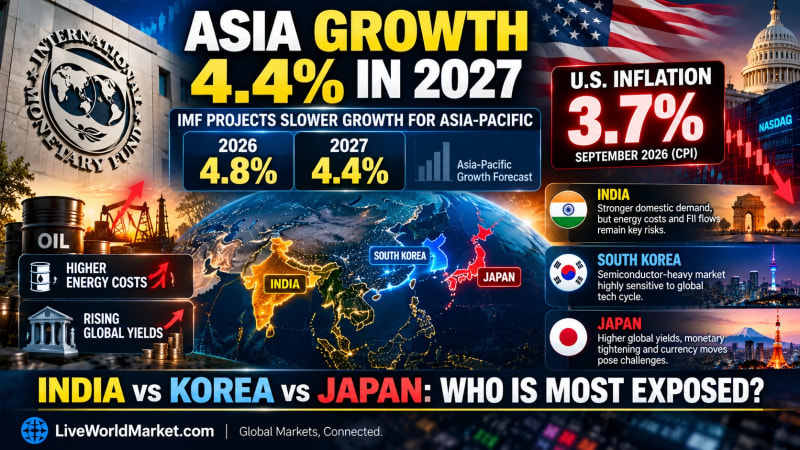
IMF Asia Growth 4.4%, US CPI 3.7%: Which Stocks Are at Risk?
News · Oct 15, 2026 · 12 min read
IMF Sees Asia Growth Slowing to 4.4% as U.S. Inflation Hits 3.7%: Which Stock Markets Are Most Vulnerable? Asia's stock markets are facing a critical test as two major economic developments collide: the International Monetary Fund's warning about slower regional growth and an unexpected rise in U.S. inflation. The IMF's October Asia-Pacific outlook projects regional economic…
Read more...
China Exports Surge 36.3%, PPI Hits 5%: Stock Winners & Losers
Geopolitics & Trade · Oct 14, 2026 · 11 min read
China's Exports Surge 36.3% as Factory Inflation Hits 5%: Which Global Stocks Could Win or Lose? China's factories are shipping more goods overseas than expected, but a sharp rise in producer prices is raising a new question about the profitability of the world's manufacturing powerhouse. Official data released on October 14 showed that China's exports surged 36.3%…
Read more...
CXMT DRAM Breakthrough: Samsung, SK Hynix & Micron at Risk?
Technology & Sectors · Oct 13, 2026 · 11 min read
China's CXMT DRAM Breakthrough: Could a Memory Price War Threaten Samsung, SK Hynix and Micron? The global semiconductor industry is confronting a new question: Could China's progress in memory-chip technology eventually undermine the pricing power of the world's largest DRAM manufacturers? Chinese chipmaker ChangXin Memory Technologies (CXMT) has reportedly made progress in a…
Read more...
RBI Dollar Window: Can Rupee Near ₹97 Survive $100 Oil?
Central Banks & Rates · Oct 12, 2026 · 9 min read
RBI Opens Special Dollar Window as Rupee Nears ₹97: Can India Protect Its Stock Market From $100 Oil? India's central bank has introduced a new defense against rupee weakness at a time when crude oil prices remain above $100 per barrel. The Reserve Bank of India (RBI) has announced a special dollar facility for three government-owned oil marketing companies, beginning October…
Read more...
Firmus $5B IPO Cancelled: AI Data Center Valuations at Risk
Technology & Sectors · Oct 11, 2026 · 9 min read
Nvidia-Backed Firmus Cancels $5 Billion IPO: Is Wall Street Finally Questioning AI Data Center Valuations? The global artificial intelligence investment boom has encountered a revealing reality check. Firmus Technologies, an Australian AI data center developer backed by Nvidia, has withdrawn its planned multibillion-dollar stock market listing after struggling to attract…
Read more...