
Nifty Index Rebalancing June 2026: Passive Flows, Weight Changes and What They Mean
Indian equities experienced unusual trading activity on June 29, 2026 as changes across several Nifty indices triggered adjustments by passive investment funds.
Stocks such as MCX, NTPC, Laurus Labs, Adani Power and Tata Steel were estimated to receive meaningful passive inflows, while Bharti Airtel, Eicher Motors, Asian Paints and several financial and automobile stocks were expected to see outflows.
These transactions attracted attention because index funds and exchange-traded funds must periodically adjust their portfolios to continue tracking their underlying benchmarks.
However, an index-related inflow should not automatically be interpreted as positive investor sentiment toward a company.
Similarly, an index-related outflow does not necessarily indicate that investors have become negative about a company's fundamentals.
Understanding why these flows occur is therefore more useful than simply looking at the biggest estimated buyers and sellers.
What Happened on June 29, 2026?
The June-end adjustment affected weights across a number of Nifty indices.
According to estimates from Nuvama Alternative & Quantitative Research reported around the rebalance, changes in free-float weights and scheduled adjustments across broader and strategy indices were expected to generate significant passive trading.
It is important to distinguish this from the normal Nifty 50 constituent reconstitution.
NSE Indices' official calendar normally reviews the constituents of major broad-market indices such as:
- Nifty 50;
- Nifty Next 50;
- Nifty 100;
- Nifty 200;
- Nifty 500;
- Nifty Midcap 150; and
- Nifty Smallcap 250
on a semi-annual basis, with changes generally effective on the last working day of March and September.
June can nevertheless produce substantial index activity because free-float weights can change and several strategy, factor and thematic indices follow June or quarterly review schedules.
That distinction is important when discussing an “index rejig.”
Why Do Index Weights Change?
Many Nifty indices use free-float market capitalisation rather than a company's total market capitalisation.
Free float generally represents the portion of a company's shares considered available for public trading.
Shares held by promoters and several categories of strategic shareholders are excluded when calculating the investible weight factor, or IWF.
NSE Indices uses company shareholding information to calculate these free-float factors.
If public shareholding changes, a company's effective weight in an index can change even if it remains a constituent of that index.
A higher index weight means an index fund may need to own more of the stock.
A lower weight can require the fund to reduce its holding.
That buying and selling is one reason index adjustments can generate large volumes near the effective date.
Which Stocks Were Expected to Receive the Biggest Inflows?
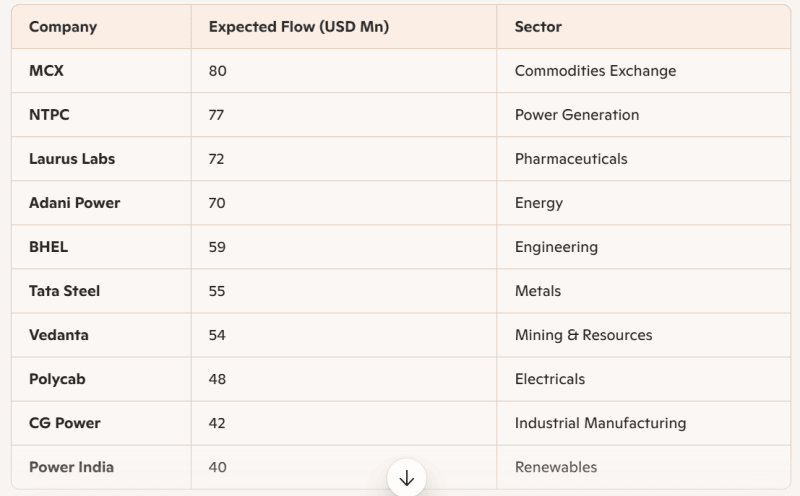
Nuvama's estimates indicated several notable cumulative passive inflows across the affected Nifty indices.
Among the largest estimates were approximately:

These figures were estimates, not guarantees of the precise amount ultimately traded.
Actual execution can vary because of market prices, tracking techniques, fund assets, corporate actions and other portfolio adjustments.
Which Stocks Were Expected to See Outflows?
The largest estimated passive outflows included:


Again, an index-driven outflow should not be interpreted as a recommendation to sell these companies.
The transactions can occur simply because their weights decline relative to other index constituents.
What Changed Inside the Nifty 50?
The June adjustment also affected individual weights within the Nifty 50.
According to the Nuvama estimates, stocks including:
- Coal India;
- ICICI Bank;
- Eternal;
- HDFC Bank; and
- Bajaj Finance
were expected to see increases in their Nifty 50 weights, generating estimated inflows of up to approximately $26 million in selected names.
Meanwhile:
- Bharti Airtel;
- State Bank of India;
- Larsen & Toubro;
- Grasim Industries; and
- Maruti Suzuki
were among stocks expected to see weight reductions.
This is different from removing or adding a company to the Nifty 50.
A company can remain a full constituent while its percentage weight changes.
Nifty Bank Also Saw Weight Adjustments
The banking index experienced its own changes.
HDFC Bank was estimated to receive approximately $37 million of passive inflows, while SBI was expected to receive approximately $29 million from index adjustments.
Axis Bank was estimated to see around $19 million of outflows, while Canara Bank and Bank of Baroda were each estimated to experience outflows of roughly $10 million.
These movements demonstrate how a relatively small change in free-float weight can translate into significant trading when large index-linked portfolios need to rebalance.
Why Passive Funds Have to Trade
Suppose an index contains Stock A at a 5% weight.
An ETF tracking that index will generally aim to maintain approximately the same exposure.
If the benchmark increases Stock A's weight from 5% to 5.5%, the ETF may need to purchase additional shares.
If its weight falls to 4.5%, the fund may need to sell shares.
Multiply this process across many ETFs, index funds and institutional portfolios and the resulting transaction value can become substantial.
This is known broadly as passive rebalancing flow.
Why Trading Volumes Can Jump Near the Closing Bell
Index re balances frequently create unusually heavy trading volumes near the end of the session.
Passive funds generally want their portfolio to resemble the benchmark as closely as possible when the new index weights become effective.
This means a large portion of re balancing activity can occur close to the closing price used by the index.
A stock can therefore experience unusually high turnover during the final part of the session without any major company-specific news.
The price may also move temporarily because of the imbalance between required buyers and sellers.
However, that price movement does not necessarily continue after the index event is complete.
Does an Index Inflow Mean the Stock Will Rise?
No.
An estimated inflow may create temporary demand, but markets can anticipate index changes well before the effective date.
Professional traders often estimate changes in advance.
Some investors may therefore buy a stock before the rebalance in anticipation of passive demand and sell once index funds complete their purchases.
This means the final price impact may be considerably different from the estimated flow.
The same applies to outflows.
A company expected to experience index selling can still rise if other market participants are willing to buy the shares.
Passive Flow Is Not the Same as FII Flow
Another useful distinction is between index-re balancing flows and the daily FII/DII numbers commonly reported after the Indian market closes.
FII and DII cash-market figures measure the aggregate net purchases and sales made by foreign and domestic institutional investors.
Index flows describe trades associated with changes in particular benchmarks.
A foreign institution could sell one stock because of an index adjustment while simultaneously purchasing another Indian stock.
Therefore, a large index-related transaction should not automatically be interpreted as a change in overall foreign sentiment toward India.
Do Index Changes Affect Company Fundamentals?
Normally, no.
An index weight change does not directly alter a company's:
- revenue;
- profit;
- cash flow;
- debt;
- competitive position; or
- business model.
The most immediate impact is generally on ownership demand from funds tracking the relevant index.
Long-term share-price performance will still depend much more heavily on the underlying business and its valuation.
This is one reason investors should avoid treating index additions, deletions or weight changes as fundamental investment recommendations.
Strategic and Factor Indices Can Create Additional Flows
The June rebalance was also relevant because several strategy indices follow different review schedules from the main Nifty 50.
Examples include indices based on:
- momentum;
- quality;
- value;
- low volatility; and
- combinations of these factors.
NSE Indices' published calendar shows that several factor indices—including Nifty200 Momentum 30, Nifty500 Momentum 50 and Nifty Midcap150 Momentum 50—have scheduled reviews around June and December.
Funds and ETFs tracking these benchmarks may therefore need to buy new qualifying stocks and sell stocks that no longer meet the relevant factor criteria.
This can produce meaningful flows even when the company's membership in a broad benchmark such as Nifty 500 remains unchanged.
What Investors Can Learn From Index Re balancing
Index events are useful because they demonstrate how modern market structure works.
Not every large trade represents a new fundamental opinion.
A substantial purchase may occur because a passive fund is mechanically required to increase exposure.
Similarly, large selling can occur without any deterioration in a company's business outlook.
Before interpreting an unusual volume spike, investors can therefore ask:
- Is there an index rebalance taking place?
- Has the company's free-float weight changed?
- Has the stock been added to or removed from a factor index?
- Is the volume concentrated near the closing auction?
- Is there separate company-specific news?
This can provide a more complete explanation of market activity.
Final Takeaway
The June 29, 2026 Nifty index adjustment generated significant estimated passive flows across Indian equities.
MCX, NTPC, Laurus Labs, Adani Power and GE Vernova T&D India were among the largest estimated beneficiaries, while Bharti Airtel, Eicher Motors, Asian Paints and several automobile and financial companies were expected to face sizable mechanical outflows.
But the most important takeaway is not which stock received the largest estimated flow.
It is understanding why those flows occurred.
Index funds follow predefined benchmark rules. When free-float weights or index constituents change, passive portfolios must adjust accordingly.
These trades can increase volume and short-term volatility but do not necessarily represent a change in the underlying company's fundamentals or investor confidence.
For investors, index rebalancing is therefore best viewed as a market-structure event rather than an automatic buy or sell signal.
Data note: Passive-flow figures in this article are estimates attributed to Nuvama Alternative & Quantitative Research around the June 29, 2026 rebalance. Estimated flows may differ from actual executed transactions.
Sources: NSE Indices methodology and index reconstitution calendar; passive-flow estimates attributed to Nuvama Alternative & Quantitative Research.
Disclaimer: This article is for educational and informational purposes only. It does not constitute investment advice, securities research or a recommendation to buy or sell any stock, ETF or financial instrument. Index changes and estimated passive flows do not guarantee future share-price performance.
Helpful Resources on LiveWorldMarket
India Stock Market Dashboard
Track Nifty 50, Sensex, Bank Nifty, market breadth, sector performance, heatmaps, gainers, losers and important Indian market developments.
Open India Stock Market Dashboard
FII/DII Market Activity
Follow foreign and domestic institutional cash-market activity alongside daily Indian market developments.
Read the Latest Pre-Market Briefing
Post-Market Wrap
Review Nifty and Sensex closing performance, sector rotation, market breadth, FII/DII activity and the major drivers of each trading session.
Technical Screener
Explore stocks using technical and market-based filters rather than treating an index inclusion or estimated passive flow as an investment signal.
Technical Chart
Analyse price action, volume, moving averages, RSI, MACD, ATR and other indicators for stocks affected by index changes.
Open LiveWorldMarket Technical Chart
Educational Note: Index additions, deletions, weight changes and passive-flow estimates describe market mechanics. They should not be treated as standalone buy or sell recommendations.
Comments (0)
Be the first to comment.
About the author

NISM-Series-X-A Investment Adviser Level 1 examination completed
Amit writes about Indian equity markets, technical analysis, macro themes and the day-to-day mechanics of trading, with a focus on making the flow of global markets legible for retail investors. He has completed the NISM-Series-X-A Investment Adviser Level 1 examination.
You May Also Like
US Midterm Elections 2026: Impact on Stocks, Dollar & India
Global Markets & Economy · Nov 4, 2026 · 10 min read
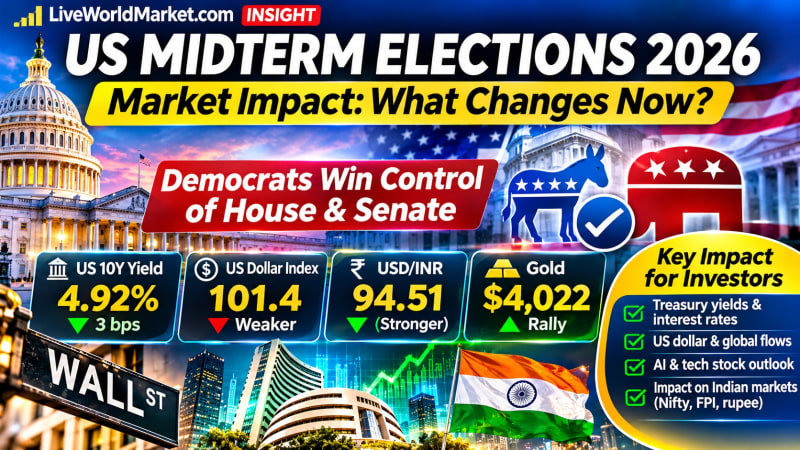
US Midterm Elections 2026: Why Treasury Yields, the Dollar and Indian Stocks Could React More Than Wall Street Key Takeaway: Democrats have won control of both chambers of the US Congress in the 2026 midterm elections, creating a divided government under President Donald Trump. The immediate market reaction has been revealing: US Treasury yields declined, the dollar weakened…
Read more...
Apple Overtakes Nvidia: Is Lower AI Spending Winning?
Technology & Sectors · Nov 2, 2026 · 9 min read
Apple Overtakes Nvidia as World's Most Valuable Company Ahead of Earnings: Is Spending Less on AI Becoming Wall Street's Winning Strategy? Key takeaway: Apple has reclaimed the title of the world's most valuable publicly traded company, overtaking Nvidia as investors reassess the enormous cost of artificial intelligence infrastructure. With Apple's upcoming earnings in focus…
Read more...
ExxonMobil Refining Profits Surge: Impact on Indian Oil Stocks
Commodities & Energy · Nov 1, 2026 · 8 min read
ExxonMobil's Refining Profits Overtake Oil Drilling for First Time in 6 Years: Why India's Oil Stocks May Miss the Windfall Key Takeaway: ExxonMobil's refining business has emerged as a bigger earnings contributor than oil production, highlighting an extraordinary shift in global energy markets. But Indian oil companies such as IOC, BPCL and HPCL face a different challenge…
Read more...
Fed Decision and Microsoft–Google Earnings: Two Critical Tests for the AI Stock Market Rally
Global Markets & Economy · Oct 28, 2026 · 15 min read
Global stock markets are approaching one of the most important financial evenings of October 2026. The U.S. Federal Reserve is preparing to announce its latest interest-rate decision, while Microsoft and Alphabet, Google's parent company, are scheduled to publish quarterly earnings after Wall Street closes. These developments arrive as investors reassess the sustainability of…
Read more...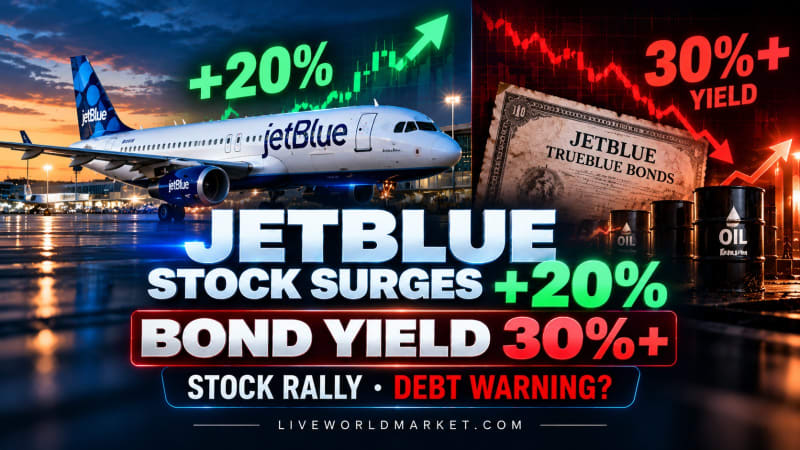
JetBlue Stock Surges 20%, Bond Yield Tops 30%: Warning?
Global Markets & Economy · Oct 28, 2026 · 16 min read
JetBlue Stock Surges 20% While Its Bonds Yield Over 30%: Is Airline Debt Flashing a Warning for Investors? Something unusual is happening in the U.S. airline industry. Shares of JetBlue Airways surged approximately 20% on October 27, after the airline raised its revenue outlook and attempted to reassure investors about its financial position. But an entirely different story…
Read more...
US Consumer Staples Rally 9.6%: FMCG Valuation Risk for India
Global Markets & Economy · Oct 25, 2026 · 16 min read
US Consumer Staples Surge 9.6% as Valuations Overtake Tech: Is the Safe-Stock Trade Becoming a Trap for Indian FMCG Investors? Something unexpected is happening on Wall Street. As investors become increasingly cautious about expensive artificial intelligence stocks, money has been moving into an unlikely market leader: consumer staples. The U.S. consumer-staples sector has…
Read more...
SpaceX 80,000 Cell Sites: Will Starlink Challenge Jio & Airtel?
Global Markets & Economy · Oct 24, 2026 · 17 min read
SpaceX's 80,000 Cell-Site Plan Sends US Telecom Stocks Down 8%: Could Starlink Disrupt Jio and Airtel Next? A major shift may be emerging in the global telecommunications industry—and Wall Street has already started reacting. Shares of American telecommunications giants AT&T and T-Mobile plunged nearly 8% on October 23 after reports revealed that Elon Musk's SpaceX was…
Read more...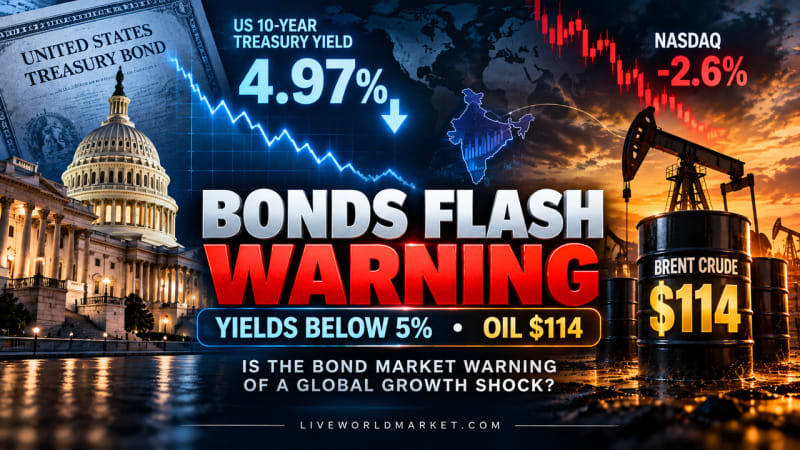
US 10-Year Treasury Yield Below 5%: Growth Shock Warning?
Central Banks & Rates · Oct 23, 2026 · 17 min read
US 10-Year Treasury Yield Falls Below 5% Despite $114 Oil: Is the Bond Market Warning of a Global Growth Shock? Something unusual is happening across global financial markets. The yield on the benchmark U.S. 10-year Treasury has fallen sharply below the psychologically important 5% level, even as Brent crude oil has surged toward $114 per barrel and technology stocks have…
Read more...
Brent Crude Tops $110: Impact on Indian Stocks & Earnings
Global Markets & Economy · Oct 22, 2026 · 14 min read
Brent Crude Tops $110: Why Indian Airlines, Paints and Tyre Stocks Face a Hidden Earnings Risk Brent crude oil has climbed above $110 per barrel, intensifying concerns that rising global energy prices could squeeze corporate profit margins, increase India's import costs and create further volatility in domestic equities. On October 22, Brent futures traded above $111 after…
Read more...
India Optical Fibre Exports Jump 158%: AI's Hidden Winners
Global Markets & Economy · Oct 21, 2026 · 12 min read
India's Optical Fibre Exports Jump 158% as Japan's Chip Shipments Surge 49%: The Hidden Winners of the AI Infrastructure Boom Artificial intelligence may be transforming the technology industry, but some of its most important economic beneficiaries are not necessarily the companies developing AI models. They may be the businesses manufacturing the physical infrastructure that…
Read more...