
IMF Global Growth Forecast 2026: India Leads as War and AI Reshape the World Economy
The global economy is entering the second half of 2026 with two powerful forces pulling in opposite directions.
On one side, higher energy prices and geopolitical disruption in the Middle East are creating pressure on inflation, consumers and energy-importing economies.
On the other, strong investment in artificial intelligence, semiconductors, data centres and related technology infrastructure is supporting activity in countries closely connected to the global technology supply chain.
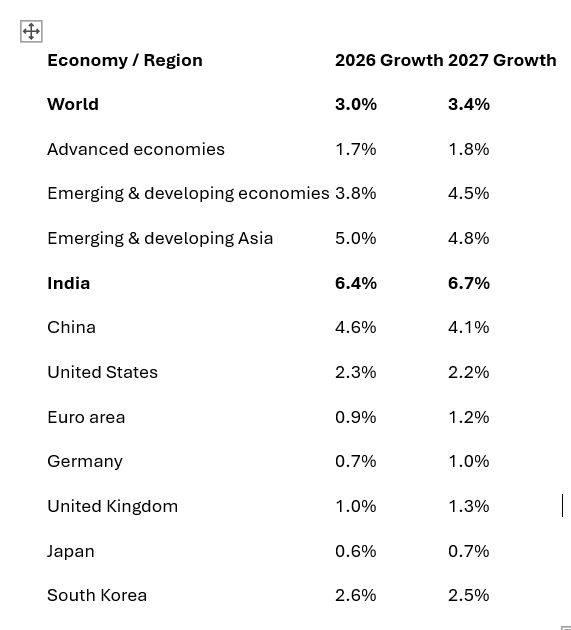
In its July 2026 World Economic Outlook Update, the International Monetary Fund projected global economic growth of 3.0% in 2026, followed by a rebound to 3.4% in 2027.
The overall global number, however, hides major differences between countries.
IMF 2026 Growth Forecast at a Glance

Note: IMF India projections are presented on a fiscal-year basis.
India Remains One of the Fastest-Growing Major Economies
India continues to stand out in the IMF's global projections.
The IMF now expects India's economy to grow by 6.4% in FY 2026/27, followed by 6.7% in FY 2027/28.
The 2026 forecast represents a small 0.1 percentage-point downgrade compared with the April projection of 6.5%.
The reason is important.
India's recent economic data have been relatively resilient, but the IMF expects higher energy prices to offset some of that strength.
India imports a substantial portion of its crude-oil requirements, meaning prolonged increases in global energy prices can affect inflation, transportation costs, corporate margins and the country's import bill.
The IMF nevertheless raised India's 2027 forecast by 0.2 percentage point to 6.7%, expecting growth to strengthen as the energy shock gradually fades.
China's Forecast Was Upgraded
China's 2026 growth forecast moved in the opposite direction.
The IMF raised its projection from 4.4% in April to 4.6% in July.
One important reason was stronger-than-expected first-quarter economic performance.
China recorded approximately 5% year-on-year growth during the first quarter, which provided a stronger starting point for the full year.
However, the IMF still expects Chinese growth to slow to 4.1% in 2027.
Longer-term challenges remain, including weaker domestic demand, demographic pressures, slower productivity growth and difficulties in the property sector.
United States Remains Relatively Resilient
The IMF expects the United States to grow by approximately 2.3% in 2026, broadly unchanged from its April forecast.
Growth is projected to moderate slightly to 2.2% in 2027.
Several factors are helping the U.S. economy.
Fiscal policy remains supportive, financial conditions have remained relatively accommodative by historical standards, and enormous investment in AI infrastructure continues to support business spending.
The U.S. is also less vulnerable to the current energy shock than many other advanced economies because it is a major oil and gas producer.
This helps explain why the economic impact of higher global energy prices differs substantially between the United States and energy-importing economies.
Europe Faces a More Difficult 2026
Europe has a weaker outlook.
The IMF expects euro-area growth of only 0.9% in 2026, followed by 1.2% in 2027.
The 2026 projection was lowered by 0.2 percentage point compared with April.
Higher energy prices are an important reason.
Europe remains relatively sensitive to international energy costs, while consumer confidence and broader economic momentum have also remained weak.
The IMF separately warned that the Middle East conflict has increased inflationary pressure across the euro area, projecting headline inflation of approximately 2.9% in 2026.
Germany is expected to grow by around 0.7%, France by 0.6% and Italy by 0.5% during 2026.
Spain remains considerably stronger with expected growth of approximately 2.1%.
AI Is Becoming a Macroeconomic Growth Driver
One of the most interesting features of the IMF's July outlook is the importance given to artificial intelligence.
AI is no longer simply a stock-market theme.
Huge investments in semiconductors, data centres, cloud infrastructure, power systems and related technologies are beginning to influence economic growth.
Countries integrated into this technology supply chain are benefiting disproportionately.
South Korea provides one example.
The IMF raised Korea's 2026 growth forecast substantially to 2.6%, with AI-related semiconductor investment helping support activity.
This creates a very different global environment from one driven primarily by consumer spending or conventional manufacturing.
Energy Is Pulling in the Opposite Direction
While technology investment supports growth, energy disruption is slowing parts of the world economy.
The IMF described the global outlook as being caught in the “crosscurrents of war and technology.”
Energy-importing countries face higher costs.
Energy exporters can sometimes benefit from stronger commodity prices.
This creates different outcomes even when countries experience the same geopolitical event.
The Middle East and North Africa provide an extreme example. The IMF expects regional growth to fall sharply in 2026 before rebounding in 2027 as energy disruption eases.
For India, Europe and several Asian economies, crude oil therefore remains one of the most important variables to monitor during the remainder of 2026.
Global Inflation Is Again a Concern
Perhaps the less encouraging part of the IMF update is inflation.
The IMF raised its 2026 global headline-inflation forecast to 4.7%.
It also said the disinflation trend that had been underway since early 2024 has effectively stalled.
This matters for financial markets because higher inflation can affect central-bank decisions.
If inflation remains persistent, policymakers may be less willing to reduce interest rates aggressively.
That can influence:
- government bond yields;
- corporate borrowing costs;
- consumer loans;
- currencies;
- stock-market valuations; and
- capital flows into emerging markets.
Therefore, GDP growth alone does not provide a complete picture of the global investment environment.
Emerging Asia Still Leads Global Growth
Despite the slowdown, Asia remains one of the fastest-growing major regions.
The IMF expects emerging and developing Asia to expand by approximately 5.0% in 2026, substantially faster than the 1.7% expected across advanced economies.
India's 6.4% growth forecast places it above China and most other large economies.
Indonesia is projected at around 5.0%, Malaysia at 4.7%, while South Korea's technology-led growth outlook has improved.
However, faster economic growth does not automatically guarantee stronger stock-market returns.
Equity performance also depends on:
valuations, corporate profits, interest rates, currency movements and investor expectations.
A country can grow rapidly while its stock market struggles if valuations were already excessive.
What Could Change the IMF Forecast?
Economic forecasts are conditional estimates rather than guarantees.
The IMF highlighted several major uncertainties.
A worsening Middle East conflict could cause renewed energy disruption.
Oil prices could remain higher for longer.
Inflation could become more persistent.
Financial markets could experience a significant valuation correction.
Trade-policy tensions could intensify.
On the positive side, stronger AI-related productivity gains, easing geopolitical tensions or faster normalization in energy markets could produce better outcomes.
This is why IMF forecasts are updated several times each year.
What Does the Outlook Mean for India?
For India, the combination is relatively favourable but not risk-free.
Growth remains strong compared with other major economies.
Corporate earnings and domestic demand can benefit from that expansion.
But India's dependence on imported energy means a sustained oil shock could create pressure through inflation, the rupee and business costs.
Global bond yields also matter because foreign investors compare Indian equities with investment opportunities available around the world.
Therefore, investors should not interpret India's 6.4% GDP growth forecast as a direct prediction for the Nifty 50 or Sensex.
GDP growth and stock-market returns are related only indirectly.
Final Takeaway
The IMF's July 2026 outlook presents a global economy that remains resilient but increasingly uneven.
Global growth: 3.0%
India: 6.4%
China: 4.6%
United States: 2.3%
Euro area: 0.9%
India remains among the fastest-growing major economies, while the United States continues to show resilience.
China received a modest upgrade, while Europe faces greater pressure from energy costs.
The larger global story is the competition between two powerful economic forces:
AI and technology investment are supporting growth, while geopolitical conflict and expensive energy are holding it back.
Whether one force becomes dominant will play an important role in determining the global economic and financial-market outlook through the remainder of 2026 and into 2027.
Updated: August 22, 2026
Source note: Growth projections are based primarily on the IMF World Economic Outlook Update, July 2026: Global Economy in Crosscurrents of War and Technology.
Disclaimer: This article is for educational and informational purposes only. Economic forecasts are estimates and may change as new information becomes available. GDP projections should not be considered investment advice or predictions of stock-market returns.
Helpful Resources on LiveWorldMarket
For readers who want to connect the IMF outlook with current financial markets:
Global Stock Markets in 2026 — Compare the U.S., Europe, India and Asian equity-market environment.
India Stock Market Dashboard — Follow Nifty, Sensex, sectors, volatility and current Indian market conditions.
U.S. Stock Market Dashboard — Track major U.S. indices and market developments.
Europe Stock Market Dashboard — Follow the DAX, FTSE, CAC 40 and other European markets.
Currency & Commodity Briefing — Monitor crude oil, gold, silver and currencies that can influence inflation and economic growth.
Comments (0)
Be the first to comment.
About the author

NISM-Series-X-A Investment Adviser Level 1 examination completed
Amit writes about Indian equity markets, technical analysis, macro themes and the day-to-day mechanics of trading, with a focus on making the flow of global markets legible for retail investors. He has completed the NISM-Series-X-A Investment Adviser Level 1 examination.
You May Also Like

US Midterm Elections 2026: Impact on Stocks, Dollar & India
Global Markets & Economy · Nov 4, 2026 · 10 min read
US Midterm Elections 2026: Why Treasury Yields, the Dollar and Indian Stocks Could React More Than Wall Street Key Takeaway: Democrats have won control of both chambers of the US Congress in the 2026 midterm elections, creating a divided government under President Donald Trump. The immediate market reaction has been revealing: US Treasury yields declined, the dollar weakened…
Read more...
Apple Overtakes Nvidia: Is Lower AI Spending Winning?
Technology & Sectors · Nov 2, 2026 · 9 min read
Apple Overtakes Nvidia as World's Most Valuable Company Ahead of Earnings: Is Spending Less on AI Becoming Wall Street's Winning Strategy? Key takeaway: Apple has reclaimed the title of the world's most valuable publicly traded company, overtaking Nvidia as investors reassess the enormous cost of artificial intelligence infrastructure. With Apple's upcoming earnings in focus…
Read more...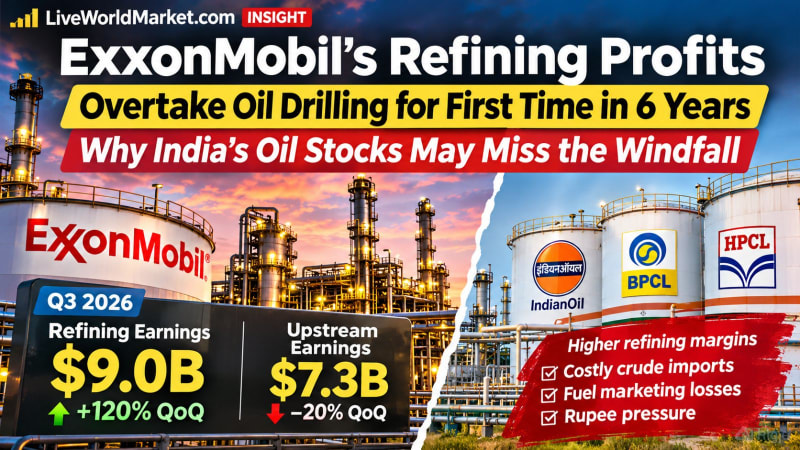
ExxonMobil Refining Profits Surge: Impact on Indian Oil Stocks
Commodities & Energy · Nov 1, 2026 · 8 min read
ExxonMobil's Refining Profits Overtake Oil Drilling for First Time in 6 Years: Why India's Oil Stocks May Miss the Windfall Key Takeaway: ExxonMobil's refining business has emerged as a bigger earnings contributor than oil production, highlighting an extraordinary shift in global energy markets. But Indian oil companies such as IOC, BPCL and HPCL face a different challenge…
Read more...
Fed Decision and Microsoft–Google Earnings: Two Critical Tests for the AI Stock Market Rally
Global Markets & Economy · Oct 28, 2026 · 15 min read
Global stock markets are approaching one of the most important financial evenings of October 2026. The U.S. Federal Reserve is preparing to announce its latest interest-rate decision, while Microsoft and Alphabet, Google's parent company, are scheduled to publish quarterly earnings after Wall Street closes. These developments arrive as investors reassess the sustainability of…
Read more...
JetBlue Stock Surges 20%, Bond Yield Tops 30%: Warning?
Global Markets & Economy · Oct 28, 2026 · 16 min read
JetBlue Stock Surges 20% While Its Bonds Yield Over 30%: Is Airline Debt Flashing a Warning for Investors? Something unusual is happening in the U.S. airline industry. Shares of JetBlue Airways surged approximately 20% on October 27, after the airline raised its revenue outlook and attempted to reassure investors about its financial position. But an entirely different story…
Read more...
US Consumer Staples Rally 9.6%: FMCG Valuation Risk for India
Global Markets & Economy · Oct 25, 2026 · 16 min read
US Consumer Staples Surge 9.6% as Valuations Overtake Tech: Is the Safe-Stock Trade Becoming a Trap for Indian FMCG Investors? Something unexpected is happening on Wall Street. As investors become increasingly cautious about expensive artificial intelligence stocks, money has been moving into an unlikely market leader: consumer staples. The U.S. consumer-staples sector has…
Read more...
SpaceX 80,000 Cell Sites: Will Starlink Challenge Jio & Airtel?
Global Markets & Economy · Oct 24, 2026 · 17 min read
SpaceX's 80,000 Cell-Site Plan Sends US Telecom Stocks Down 8%: Could Starlink Disrupt Jio and Airtel Next? A major shift may be emerging in the global telecommunications industry—and Wall Street has already started reacting. Shares of American telecommunications giants AT&T and T-Mobile plunged nearly 8% on October 23 after reports revealed that Elon Musk's SpaceX was…
Read more...
US 10-Year Treasury Yield Below 5%: Growth Shock Warning?
Central Banks & Rates · Oct 23, 2026 · 17 min read
US 10-Year Treasury Yield Falls Below 5% Despite $114 Oil: Is the Bond Market Warning of a Global Growth Shock? Something unusual is happening across global financial markets. The yield on the benchmark U.S. 10-year Treasury has fallen sharply below the psychologically important 5% level, even as Brent crude oil has surged toward $114 per barrel and technology stocks have…
Read more...
Brent Crude Tops $110: Impact on Indian Stocks & Earnings
Global Markets & Economy · Oct 22, 2026 · 14 min read
Brent Crude Tops $110: Why Indian Airlines, Paints and Tyre Stocks Face a Hidden Earnings Risk Brent crude oil has climbed above $110 per barrel, intensifying concerns that rising global energy prices could squeeze corporate profit margins, increase India's import costs and create further volatility in domestic equities. On October 22, Brent futures traded above $111 after…
Read more...
India Optical Fibre Exports Jump 158%: AI's Hidden Winners
Global Markets & Economy · Oct 21, 2026 · 12 min read
India's Optical Fibre Exports Jump 158% as Japan's Chip Shipments Surge 49%: The Hidden Winners of the AI Infrastructure Boom Artificial intelligence may be transforming the technology industry, but some of its most important economic beneficiaries are not necessarily the companies developing AI models. They may be the businesses manufacturing the physical infrastructure that…
Read more...