
India’s Top 10 Most Valuable Unlisted Companies in 2026
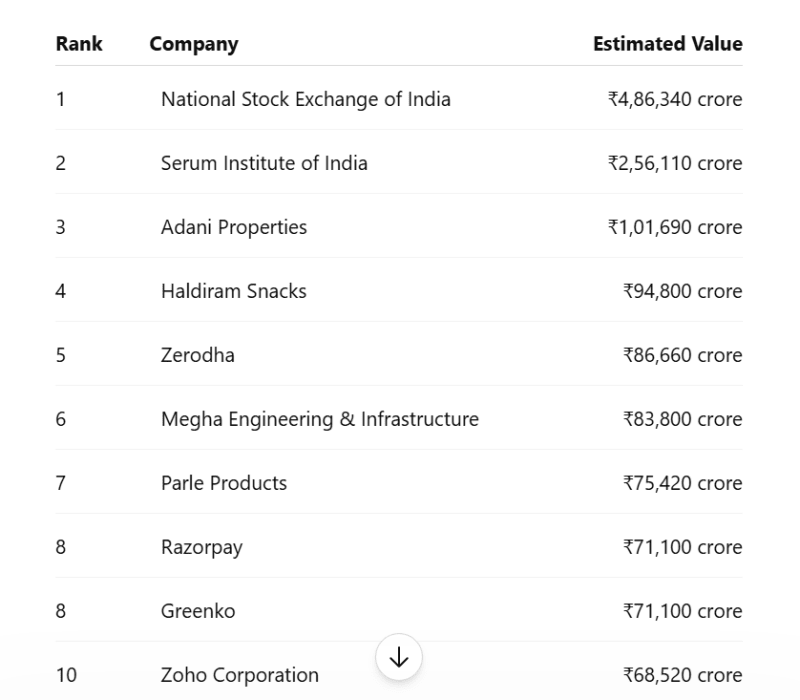
India’s corporate landscape extends far beyond companies listed on the NSE and BSE.
Some of the country’s largest and best-known businesses remain privately held or unlisted, including the National Stock Exchange itself, vaccine manufacturer Serum Institute of India, brokerage platform Zerodha, food companies Haldiram and Parle Products, and technology businesses such as Razorpay and Zoho.
According to the 2025 Burgundy Private Hurun India 500, released in June 2026, the National Stock Exchange remains India’s most valuable unlisted company with an estimated value of approximately ₹4.86 lakh crore.
But investors should understand an important distinction.
These figures are estimated enterprise or equity values used in the Hurun ranking, not live stock-market capitalisations. Because the shares are not freely traded on a public stock exchange, their valuations can be more difficult to verify and can change significantly between private transactions.
India’s Top 10 Unlisted Companies

These figures are based on Hurun Research Institute estimates and should be treated as a snapshot rather than continuously updated market prices.
1. National Stock Exchange of India — ₹4.86 Lakh Crore
The National Stock Exchange remains the most valuable unlisted company in the Hurun ranking.
NSE operates India’s largest securities exchange and plays a central role in equity, derivatives, currency and debt-market trading.
Its importance to India’s financial infrastructure helps explain its unusually high valuation.
The exchange was valued at approximately ₹4,86,340 crore, up around 3% from the previous ranking.
NSE has also been preparing for a potential public listing, making it one of the most closely watched unlisted companies in India.
However, until an IPO is completed and the shares begin trading publicly, NSE remains an unlisted company.
2. Serum Institute of India — ₹2.56 Lakh Crore
Serum Institute of India ranks second with an estimated valuation of approximately ₹2,56,110 crore.
The Pune-based company is one of the world’s largest vaccine manufacturers by number of doses produced.
Its global healthcare presence expanded considerably during the COVID-19 period, but the company’s business extends well beyond pandemic-related vaccines.
Serum’s valuation increased by approximately 21% in the latest Hurun ranking.
The company remains privately controlled and is therefore not directly available through NSE or BSE.
3. Adani Properties — ₹1.02 Lakh Crore
Adani Properties ranks third at approximately ₹1,01,690 crore.
The Hurun ranking showed a substantial increase in its estimated value compared with the previous year.
The business represents the real-estate interests associated with the Adani Group and participates in residential, commercial and large-scale development projects.
This is also an example of why exact company names matter.
The ranking uses Adani Properties, so the article should not substitute a different legal company name without clarification.
4. Haldiram Snacks — ₹94,800 Crore
Haldiram is one of India’s most recognisable food brands.
Its product portfolio includes traditional Indian snacks, sweets, packaged foods and restaurant operations.
Hurun valued Haldiram Snacks at approximately ₹94,800 crore, representing one of the biggest year-on-year valuation increases among the top unlisted companies.
The brand demonstrates that India’s most valuable private businesses are not limited to fintech or technology.
Consumer brands with strong distribution and long-standing customer recognition can command very large valuations.
5. Zerodha — ₹86,660 Crore
Zerodha transformed India’s retail brokerage industry through low-cost online trading.
Founded by Nithin and Nikhil Kamath, the Bengaluru-based company has built a large customer base while remaining privately owned.
Hurun estimated Zerodha’s value at approximately ₹86,660 crore.
The company is particularly interesting because, unlike many venture-funded technology firms, Zerodha built its business without depending heavily on repeated external funding rounds.
Its continued private ownership also demonstrates that a successful business does not necessarily need to pursue an IPO quickly.
6. Megha Engineering & Infrastructure — ₹83,800 Crore
Megha Engineering & Infrastructure, commonly known as MEIL, is valued at approximately ₹83,800 crore.
The Hyderabad-based company operates across engineering, infrastructure, energy, transport and large-scale construction projects.
Infrastructure businesses can be less visible to retail investors than consumer or technology brands, but they can still become extremely large private enterprises because of the scale and duration of major projects.
7. Parle Products — ₹75,420 Crore
Parle Products remains one of India’s most recognised packaged-food companies.
Its Parle-G biscuits are among the most familiar consumer products in the country, but the business also has a much broader portfolio across biscuits, confectionery and snacks.
Hurun valued the privately held company at approximately ₹75,420 crore.
Parle demonstrates the importance of distribution, brand recognition and consumer reach in building long-term enterprise value.
8. Razorpay — ₹71,100 Crore
Razorpay is one of India’s major fintech and payments infrastructure companies.
It provides businesses with payment-processing tools, banking solutions and related financial technology.
Hurun estimated Razorpay’s value at approximately ₹71,100 crore, placing it among India’s largest private fintech businesses.
Fintech valuations can change rapidly because they are influenced by revenue growth, profitability, regulatory conditions, private funding markets and expectations about future listings.
The Hurun figure should therefore not be treated as a continuously tradable market value.
9. Greenko — ₹71,100 Crore
Greenko also carries an estimated value of approximately ₹71,100 crore.
The Hyderabad-based company operates in renewable energy and energy-storage infrastructure.
India’s growing electricity demand, renewable-energy targets and need for grid-scale storage have increased investor interest in this sector.
Greenko’s inclusion in the top ten demonstrates how infrastructure linked to the energy transition is becoming an increasingly important part of India’s private corporate economy.
10. Zoho Corporation — ₹68,520 Crore
Zoho Corporation is one of India’s best-known privately held software companies.
The company develops cloud-based business software covering areas such as customer relationship management, accounting, workplace collaboration and enterprise applications.
Hurun valued Zoho at approximately ₹68,520 crore.
The latest ranking showed a decline in estimated value compared with the previous year.
That is useful context because private-company valuations do not only move upward.
Changes in technology valuations, revenue expectations, profitability and comparable public-market companies can all influence estimated values.
What Does “Unlisted Company” Mean?
An unlisted company does not have shares freely traded on a recognised public stock exchange such as NSE or BSE.
That does not necessarily mean nobody can own or trade its shares.
Some unlisted shares can change hands through:
- employee share sales;
- existing shareholder transfers;
- private investment transactions; or
- specialised unlisted-share intermediaries.
But these transactions are very different from buying a publicly listed stock through a normal trading account.
Why Unlisted Shares Carry Additional Risk
Investors sometimes become interested in unlisted shares because they hope to invest before a future IPO.
That can create attractive opportunities in some cases, but the risks are substantial.
Limited liquidity
Finding a buyer for unlisted shares can be difficult.
A quoted price does not guarantee that the investor can actually sell the shares at that price.
Difficult price discovery
Listed shares trade continuously through public order books.
Unlisted shares may have only occasional private transactions, making fair value harder to determine.
Less frequent information
Public companies are subject to extensive stock-exchange disclosure requirements.
Information on private companies can be less accessible.
IPO uncertainty
A company described as an “IPO candidate” may postpone its listing for years or may never list.
Valuation risk
An investor buying unlisted shares at a high private-market valuation could still lose money even if the company eventually conducts an IPO.
An IPO does not automatically guarantee a higher price.
Is Valuation the Same as Market Capitalisation?
Not exactly.
For a listed company:
Market capitalisation = current share price × outstanding shares
Because the stock trades publicly, the market value changes continuously.
For an unlisted company, valuation may instead be estimated using:
- private transactions;
- comparable listed companies;
- earnings multiples;
- revenue multiples;
- funding rounds; and
- other valuation methodologies.
This is why a ranking such as Hurun’s should be described as an estimated valuation ranking, not a live market-cap table.
Which Companies Could Eventually List?
Potential IPOs often generate significant interest.
NSE is among the most closely followed candidates because of the scale of its business and its central role in Indian capital markets.
Other large private businesses may also consider public listings depending on capital requirements, shareholder objectives, regulatory conditions and market valuations.
However, investors should avoid treating media reports about a possible IPO as confirmation.
Until a company files the necessary documents, receives regulatory approvals and formally launches an offering, plans can still change.
What This Ranking Tells Us About Corporate India
The top ten show how diverse India’s private sector has become.
Financial-market infrastructure is represented by NSE.
Healthcare is represented by Serum Institute.
Consumer businesses include Haldiram and Parle.
Technology and fintech include Zerodha, Razorpay and Zoho.
Renewable energy is represented by Greenko.
Infrastructure appears through MEIL.
This diversity demonstrates that some of India’s most valuable businesses continue to operate outside public stock markets.
Final Takeaway
India’s unlisted-company ecosystem contains businesses worth tens of thousands of crores, led by the National Stock Exchange at an estimated ₹4.86 lakh crore.
Serum Institute, Adani Properties, Haldiram, Zerodha, MEIL, Parle, Razorpay, Greenko and Zoho make up the remainder of the latest Hurun top-ten ranking.
But investors should not treat this as a list of recommended investments.
Unlisted-company valuations are estimates rather than continuously observable market prices. Liquidity can be limited, disclosures can differ from public companies and future IPO plans remain uncertain.
The ranking is therefore most useful as a snapshot of India’s private corporate economy, not as a ready-made portfolio of pre-IPO opportunities.
Data source: 2025 Burgundy Private Hurun India 500, released in June 2026. Values represent Hurun Research Institute estimates and are not live market capitalisations.
Updated: August 22, 2026
Disclaimer: This article is for educational and informational purposes only. It does not constitute investment advice, a recommendation to purchase unlisted shares or an endorsement of any company. Unlisted securities can involve significant liquidity, valuation and information risks. Investors should conduct independent due diligence and seek qualified professional advice before considering such investments.
Helpful Resources on LiveWorldMarket
India Stock Market Dashboard
Compare the broader listed Indian equity market with the private-company ecosystem covered in this article.
Open India Stock Market Dashboard
India’s Corporate Transformation: 2015 to 2026
See how India’s largest listed companies have changed over the past decade.
Read India’s Corporate Transformation
India’s Oldest Listed Companies
Explore historic Indian businesses that eventually became publicly traded companies.
Read India’s Oldest Listed Companies
Nifty 50 Valuation Guide
Understand how market capitalisation and earnings valuation work for publicly traded companies.
Read the Nifty 50 Valuation Guide
Educational Note: Private-company valuation, secondary-market prices and possible IPO plans can change significantly. Unlisted-share valuations should not be treated like live NSE/BSE market prices.
Comments (0)
Be the first to comment.
About the author

NISM-Series-X-A Investment Adviser Level 1 examination completed
Amit writes about Indian equity markets, technical analysis, macro themes and the day-to-day mechanics of trading, with a focus on making the flow of global markets legible for retail investors. He has completed the NISM-Series-X-A Investment Adviser Level 1 examination.
You May Also Like

US Midterm Elections 2026: Impact on Stocks, Dollar & India
Global Markets & Economy · Nov 4, 2026 · 10 min read
US Midterm Elections 2026: Why Treasury Yields, the Dollar and Indian Stocks Could React More Than Wall Street Key Takeaway: Democrats have won control of both chambers of the US Congress in the 2026 midterm elections, creating a divided government under President Donald Trump. The immediate market reaction has been revealing: US Treasury yields declined, the dollar weakened…
Read more...
Apple Overtakes Nvidia: Is Lower AI Spending Winning?
Technology & Sectors · Nov 2, 2026 · 9 min read
Apple Overtakes Nvidia as World's Most Valuable Company Ahead of Earnings: Is Spending Less on AI Becoming Wall Street's Winning Strategy? Key takeaway: Apple has reclaimed the title of the world's most valuable publicly traded company, overtaking Nvidia as investors reassess the enormous cost of artificial intelligence infrastructure. With Apple's upcoming earnings in focus…
Read more...
ExxonMobil Refining Profits Surge: Impact on Indian Oil Stocks
Commodities & Energy · Nov 1, 2026 · 8 min read
ExxonMobil's Refining Profits Overtake Oil Drilling for First Time in 6 Years: Why India's Oil Stocks May Miss the Windfall Key Takeaway: ExxonMobil's refining business has emerged as a bigger earnings contributor than oil production, highlighting an extraordinary shift in global energy markets. But Indian oil companies such as IOC, BPCL and HPCL face a different challenge…
Read more...
Fed Decision and Microsoft–Google Earnings: Two Critical Tests for the AI Stock Market Rally
Global Markets & Economy · Oct 28, 2026 · 15 min read
Global stock markets are approaching one of the most important financial evenings of October 2026. The U.S. Federal Reserve is preparing to announce its latest interest-rate decision, while Microsoft and Alphabet, Google's parent company, are scheduled to publish quarterly earnings after Wall Street closes. These developments arrive as investors reassess the sustainability of…
Read more...
JetBlue Stock Surges 20%, Bond Yield Tops 30%: Warning?
Global Markets & Economy · Oct 28, 2026 · 16 min read
JetBlue Stock Surges 20% While Its Bonds Yield Over 30%: Is Airline Debt Flashing a Warning for Investors? Something unusual is happening in the U.S. airline industry. Shares of JetBlue Airways surged approximately 20% on October 27, after the airline raised its revenue outlook and attempted to reassure investors about its financial position. But an entirely different story…
Read more...
US Consumer Staples Rally 9.6%: FMCG Valuation Risk for India
Global Markets & Economy · Oct 25, 2026 · 16 min read
US Consumer Staples Surge 9.6% as Valuations Overtake Tech: Is the Safe-Stock Trade Becoming a Trap for Indian FMCG Investors? Something unexpected is happening on Wall Street. As investors become increasingly cautious about expensive artificial intelligence stocks, money has been moving into an unlikely market leader: consumer staples. The U.S. consumer-staples sector has…
Read more...
SpaceX 80,000 Cell Sites: Will Starlink Challenge Jio & Airtel?
Global Markets & Economy · Oct 24, 2026 · 17 min read
SpaceX's 80,000 Cell-Site Plan Sends US Telecom Stocks Down 8%: Could Starlink Disrupt Jio and Airtel Next? A major shift may be emerging in the global telecommunications industry—and Wall Street has already started reacting. Shares of American telecommunications giants AT&T and T-Mobile plunged nearly 8% on October 23 after reports revealed that Elon Musk's SpaceX was…
Read more...
US 10-Year Treasury Yield Below 5%: Growth Shock Warning?
Central Banks & Rates · Oct 23, 2026 · 17 min read
US 10-Year Treasury Yield Falls Below 5% Despite $114 Oil: Is the Bond Market Warning of a Global Growth Shock? Something unusual is happening across global financial markets. The yield on the benchmark U.S. 10-year Treasury has fallen sharply below the psychologically important 5% level, even as Brent crude oil has surged toward $114 per barrel and technology stocks have…
Read more...
Brent Crude Tops $110: Impact on Indian Stocks & Earnings
Global Markets & Economy · Oct 22, 2026 · 14 min read
Brent Crude Tops $110: Why Indian Airlines, Paints and Tyre Stocks Face a Hidden Earnings Risk Brent crude oil has climbed above $110 per barrel, intensifying concerns that rising global energy prices could squeeze corporate profit margins, increase India's import costs and create further volatility in domestic equities. On October 22, Brent futures traded above $111 after…
Read more...
India Optical Fibre Exports Jump 158%: AI's Hidden Winners
Global Markets & Economy · Oct 21, 2026 · 12 min read
India's Optical Fibre Exports Jump 158% as Japan's Chip Shipments Surge 49%: The Hidden Winners of the AI Infrastructure Boom Artificial intelligence may be transforming the technology industry, but some of its most important economic beneficiaries are not necessarily the companies developing AI models. They may be the businesses manufacturing the physical infrastructure that…
Read more...